

How To Install A Single Garage Door
How to Install a Garage Door
Updated: February. eleven, 2022
Tips, hints and what the didactics manuals don't tell you.
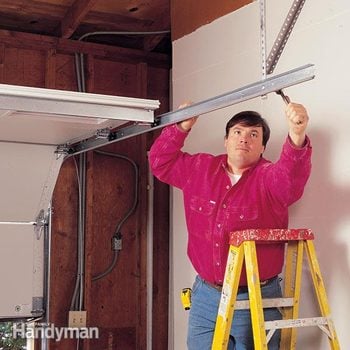
Garage door falling apart? Follow along as our expert shows how to safely install a new garage door and how to remove the old one.
Y'all might also similar: TBD
- Fourth dimension
- Complexity
- Cost
- A full twenty-four hour period
- Intermediate
- Varies
New garage door installation overview
An older double garage door can weigh anywhere from 250 to 450 lbs. This weight, coupled with deteriorating hardware, makes older garage doors a frequent scene of dwelling accidents. Even so many of u.s. enter and exit our homes through the garage door far more often than we do through the formal entry door.
In this article, nosotros'll tell you the difference between a safe door and one that's unsafe. We'll also requite you lot the helpful tips you're not probable to observe in the manufacturer's instructions to correctly, and safely, install a new garage door with a torsion spring and practice-information technology-yourself tensioning. Installing a new, double garage door yourself will salvage you lot several hundred dollars and should accept 8 to 12 hours if you're fairly handy. You can exercise most of the new garage door installation project yourself, but you should recruit assistance for removing the old door.
Circumspection!
Rent a pro to release the tension on an existing torsion spring arrangement.
2 types of springs
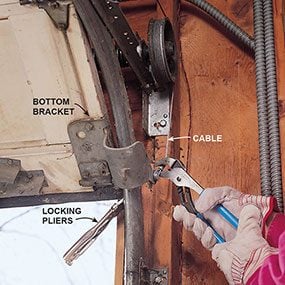
Photograph 1: Side springs: Release tension on side-mounted springs
Release the tension on side-mounted extension springs past lifting the door and locking it in place on each side with a pair of locking pliers. Tie the extension spring to the roller rail, then detach the cable from the lesser subclass with a pair of pliers.
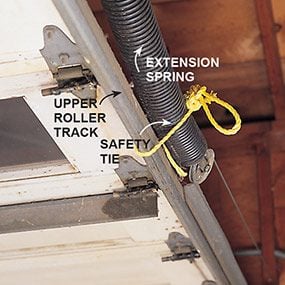
Safety tie for springs
Keep the springs in place by tying them to the track earlier yous disassemble the cablevision.

Pros only: Dealing with torsion springs
A pro will utilize special tools called winding bars to release the tension. Doing this yourself is extremely dangerous without the correct tools and feel.
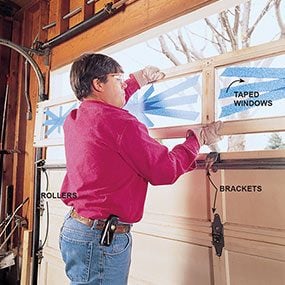
Photo 2: Remove the former door
Lower the door and dismantle it by removing the hardware. Lower a double door by recruiting at least two helpers to help with the weight, and identify a 2×4 cake under the door to prevent dandy a foot or finger when it'south lowered. Remove the sections one at a fourth dimension by disconnecting the rollers and brackets. If y'all have windows, record them to assistance control flying shards if they break. And then remove the old roller tracks and remaining hardware.
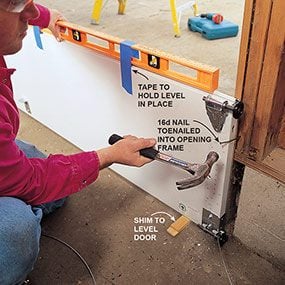
Photograph three: Install the first section
Eye and level the first section after you install the brackets. The door must be level even if the floor isn't, so apply shims nether the department to level it. The safety gasket on the bottom department will make full the gaps created by an unlevel flooring. To hold the level in place, record information technology to the department. To concur the section in place, lightly toenail a 16d blast into the frame and bend information technology over the section. Add brackets and rollers before setting them in identify and stack one section on top of another, toenailing as you lot go upward.
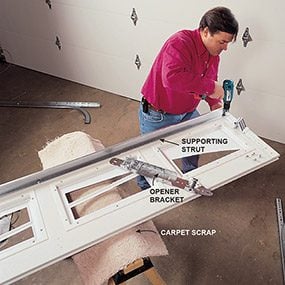
Photograph iv: Install the strut
Install the stiffening strut on top of the acme department of steel doors with the department lying flat. Then install the opener bracket that replaces the center bracket between the top 2 sections. While you're working on the sections, protect them from scratches by putting carpet scraps on acme of your sawhorses. At present, slide the rollers into the roller brackets.
Garage door springs come in two styles: torsion (see above), which mounts on the header in a higher place the door, and extension (Photograph 1), which floats above the upper roller track. In the past, extension springs were safer to install only didn't have containment cables running through the center of the spring. Without cablevision, these springs go unsafe, heavy whips when they suspension. They too tend to be noisier than torsion springs, and nosotros recommend you employ them merely if you don't accept the 12 in. of headroom above the door that a torsion leap requires.
Torsion springs have three advantages over extension springs: They're quieter, safer and easier to fine-tune. Torsion springs are quieter because yous don't have a jump knocking against a roller track. They're safer because when a leap breaks, it usually stays on the bar. Finally, you tin can fine-melody the tension on a torsion spring so the door is perfectly balanced. Setting the tension on torsion springs has always been very dangerous, simply torsion and extension spring systems with easy, do-it-yourself tensioning (Photograph 7) are available. If you don't use one of these DIY-friendly, easy tensioning systems (Clopay EZ-Set Spring and Wayne-Dalton TorqueMaster are 2 brands), you should hire a professional person to release and set the tension on a torsion spring.
Buying a steel door
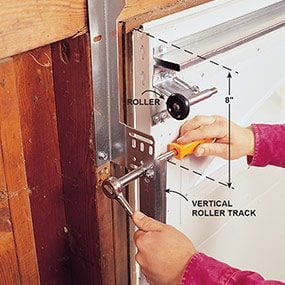
Photo 5: Install roller tracks
Install the vertical roller tracks first by wrapping the curved lip around the rollers. The pinnacle of these tracks should be approximately 8 in. below the top of the superlative section. Wait to install the upper tracks until this step is complete. Bank check the level of the superlative section to make sure the tops of the vertical roller tracks are level with each other. The lesser of the roller tracks should exist at to the lowest degree i/viii in. off the physical floor. After leveling and mounting these tracks, install the upper roller (horizontal) tracks.
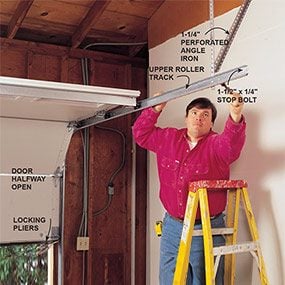
Photo half-dozen: Marshal the upper tracks
Align the upper roller tracks by carefully lifting the door halfway. Lock it in place with two locking pliers, and install the supporting brackets on the back of the rails using 1-1/iv in. perforated angle atomic number 26 (available at domicile centers and hardware stores). Install 1-1/two 10 ane/4 in. end bolts, with the threads to the within of the track, at the end of each upper rails.
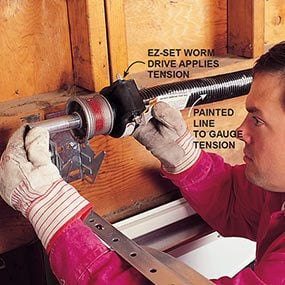
Photo vii: Gear up the torsion leap and bar
Place the spring and bar in their brackets and attach the cables, following the manufacturer'southward instructions. (Shown hither is the EZ-Set up Spring, made by Clopay.)
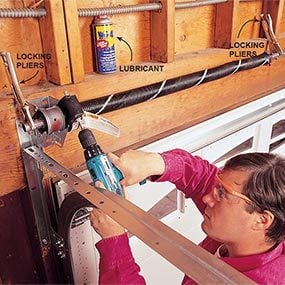
Tensioning the spring
Using your drill, add tension to the torsion spring. This organization uses a unmarried spring for a double door, but many manufacturers use ii springs for a double door. The painted line on the spring acts as a estimate for the number of turns you put on the spring. To continue the bar from turning while you're adding tension, attach a locking pliers to the bar on both ends of the spring. Apply lubricant for garage doors to the spring.
A standard double garage door is 7 ft. loftier by sixteen ft. wide. Standard single doors are 7 ft. high by 8 or 9 ft. wide. Because the doors are so big, few dwelling centers and but some garage door stores keep many doors in stock, then expect to order one instead of ownership it off the shelf. Garage doors are bachelor in wood, fiberglass and steel. Steel doors, similar ours, are low-cal, maintenance-free, affordable, readily available, and have an insulating value as high as R-19.
You tin can cull from three basic types of steel door: (1) steel but; (2) steel with insulation on the inside; and (3) steel on both sides with 1-3/eight to 2 in. of insulation. Other features that add to the toll are thicker insulation and windows, peculiarly insulated windows. The practise-it-yourself tensioning systems also add a petty to the door's cost. Be sure to specify exactly what you want.
When yous install a new garage door, replace all the hardware as well. If your automatic opener doesn't have an automatic reversing system that includes photoelectric eyes, supervene upon it. Doors with openers also crave two extra pieces of hardware that you lot'll meet in Photograph 4: a support strut (usually included in the door kit) and an opener bracket (not included). For doors with torsion springs located over the door, spend the $l or so to have a garage door professional release the tension.
After your new door is installed, remove the old stop cloth on the outside of the door and replace it with the type that has a condom weatherstrip gasket (available at home centers). Install the stop material with the door closed and with the gasket resting confronting the door at a 45-degree angle.
Vii Primal to a Safe Door Organisation
Light weight. Insulated double steel doors, fifty-fifty the heaviest ones, ordinarily weigh 150 to 200 lbs., less than one-half the weight of the wood or hardboard doors they replace. And although weight isn't an issue if the springs are properly tensioned, all springs eventually weaken and break. If you are seeing that a spring might need fixing, check out this guide to garage door jump repairs.
Pinch resistance. The most common garage door injury is a finger that gets smashed, or even amputated, when information technology'due south defenseless betwixt sections as the door moves. To help forbid these accidents, wait for a door that offers pinch-resistant section designs.
Containment cables. When old extension springs break, the springs and cables get heavy whips that damage cars and fifty-fifty hurt people. To solve the whipping trouble, manufacturers now offer containment cables that run through the center of side-mounted extension springs. If you have extension springs and don't program to replace your door, make sure the springs accept these containment cables, or have a professional install them.
Safety automatic door openers. All automated openers must now have an machine-reversing mechanism and photoelectric optics located well-nigh the flooring on both sides of the door (see photo). If the door is closing and the axle between the eyes is interrupted, the door will automatically reverse. If the optics aren't connected, the door won't operate. For instructions on how to install a new garage door opener, see How to Install a Garage Door Opener.
Securely mounted hardware and rails. Torsion spring brackets should be firmly mounted to the wooden header to a higher place the door. Roller rail support brackets and the opener should exist securely bolted to the rafters.
Annual maintenance. Make an annual bank check of all nuts and bolts on rails and rollers to brand certain they're firmly tightened. Cheque the condition of all cables to make sure they're non worn or frayed. Lubricate rollers and springs with a garage-door lubricant (see How to Set up a Noisy Garage Door for maintenance and problem-solving tips). The door should operate smoothly and be properly counterbalanced. Bank check the balance by disconnecting the opener and lowering the door halfway- the door should hold its position. If it doesn't, adjust the jump tension or replace the springs.
Opener switch location. Children similar to play with automatic door openers. To prevent them from doing this, mount whatsoever opener switches at least v ft. above the floor.
Required Tools for this Garage Door Installation Project
Have the necessary garage door tools for this DIY projection lined up before you start—you'll relieve time and frustration.
Required Materials for this Garage Door Installation Project
Avoid terminal-minute shopping trips by having all your materials set up ahead of time. Here's a list.
Originally Published: January 18, 2022

Source: https://www.familyhandyman.com/project/how-to-install-a-garage-door/
Posted by: bowerwhovestaken1938.blogspot.com
0 Response to "How To Install A Single Garage Door"
Post a Comment